


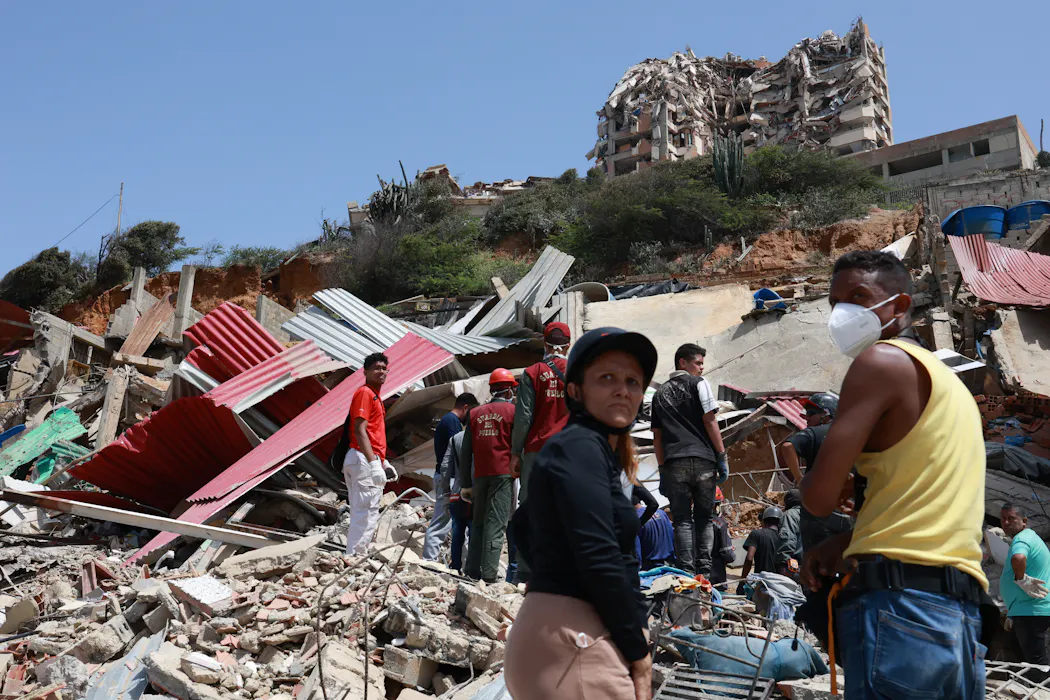
Twin earthquakes struck Venezuela on June 24, 2026, causing major damage in Caracas and a nearby coastal city, La Guaira. At the time of publication, 3,685 people have been declared dead, and more than 30,000 remain missing.
Dr. Hermes Florez and Dr. Zeina Hannoush are physicians who trained in Venezuela, then immigrated to the United States, where they now teach medicine. In a joint interview they talked about the earthquake and its aftermath, global aid efforts and the need to reform Venezuela’s healthcare system.
Dr. Hannoush, you were in Caracas during the earthquake. Can you describe what it was like?
Zeina Hannoush: I certainly felt it. It was very, very intense and long. I had been visiting my aunt and uncle, who live 15 minutes away from where I was staying. I was just standing at the exit of their building when it hit. Just two seconds before, I would have been in the elevator.
So I was already in the street when I felt the ground shaking. I walked to where I saw there were no trees or buildings and started yelling up to the people in the buildings, “Come down, come down,” because I started hearing the crashing of plates and people yelling.
The specific area of Caracas where I was located did not get profound damages like La Guaira did. And I immediately drove back to my in-laws’ house in another part of Caracas, because that’s where my kids were, and all I wanted to know is that my kids were safe.
Then there were aftershocks throughout the whole week. So we would be sleeping at night, and we would feel the bed shaking, so we’d wake up in the middle of the night and try to exit to the street.
What has each of you been doing in the aftermath of this disaster?
Hermes Florez: I came to the United States to complete my postgraduate medical training. I had planned to return to Venezuela, but as my public health and endocrinology training was ending in 2002, there was an attempted coup. I was later involved in denouncing the data censorship and healthcare deficiencies in Venezuela and was eventually placed on a blacklist. But I have found ways to collaborate with colleagues in Venezuela and others in the diaspora all over the world.
Since the earthquakes, I’ve connected with a great network of colleagues to help with relief efforts and send aid. These are people in Venezuela and in the United States, primarily around the University of Miami. There’s a great team there, as well as the Venezuelan American Medical Association. That’s allowed me to participate and provide some support to the many people affected.
What is the Venezuelan healthcare system like under normal circumstances?
Florez: There was an article published in The Lancet earlier this year, obviously before the earthquake, that was reflecting that fewer than 10% of Venezuelans are able to pay for the private hospitals or clinics, and approximately 70% of the population is impoverished.
So they have no choice but to go to the public hospitals, where a lot of things are paid out of pocket because there are no resources. On top of that, water and power supply is not always available, especially outside Caracas.
It’s a very, very challenging situation, now exacerbated by the earthquake. But a total revamp of the healthcare system is overdue.
Hannoush: The standard of practice – before the earthquake – is you go to a public hospital because you need a hip surgery or you fractured your leg. You get access to the physician who’s practicing there, but the patient leaves that evaluation with a list of the supplies that they’re going to need for their surgery.
So the patient needs to bring their own blankets and pillows and food. They need to bring the gauze, the gloves, everything. Maybe even the mattress where you’re going to need to stay in the hospital to sleep on. If you need a prosthesis, then you need to figure out how to buy it. So it is very common to see individual fundraising.
So this is how public healthcare has been taking place. And God bless the physicians practicing there.

Was there an emergency plan in place for a natural disaster like this?
Hannoush: It is a region that is known to be prone to earthquakes, but that does not mean that we have a well-structured preparedness for this kind of disaster. That’s certainly not the case. What I’ve seen is a wonderful amount of people pouring their hearts to help, but in a very disorganized way. The help is still reaching many places, but there’s so much to do that it’s quite overwhelming.
Florez: Just to put things into perspective, my dad worked for the national oil company in Venezuela for more than three decades, and there were redundancy systems to keep the power supply that was needed for oil extraction and other services that were so well planned and coordinated. All that was abandoned by the Chavez government in 2002-2003, after confronting the opposition and strikes from the experts in the oil industry. After that, there was no maintenance, no preventive measures, no exercise to anticipate catastrophic situations or things like that.
In healthcare, which is not necessarily the prime focus, it was much worse. Even though there are some guidelines that the World Health Organization and the Pan American Health Organization have in place for training healthcare personnel for emergency preparedness, nothing like that was implemented over the past two decades or so.
It’s also worth noting that there’s nothing in the construction code for the buildings in Venezuela to address earthquakes, and that is a contributing factor to poor preparation.
Is aid coming into Venezuela still, and is it getting to where it needs to go?
Hannoush: We’ve seen wonderful things happen with people coming from all corners of the world in solidarity, and I hope that this continues because Venezuela is going to need everyone’s help.
There are many people from the U.S. and reputable nonprofit organizations eager to donate, but there’s also a huge mistrust between the government and the nonprofit organizations who want to donate. We’ve had repeated instances – during COVID-19, in 1999 – where donations were given centrally to the government for the distribution, and then things did not get where they needed to go. And so that’s where this mistrust comes from.
So I’ve been trying to help on that front – getting the donations through the customs borders and then making sure that they get to the correct hospitals and to our colleagues there at ground zero.
Are you hopeful for the future of Venezuela right now?
Florez: The silver lining is that after COVID-19, because everyone needed to enhance our platforms, our virtual care and so on, we can provide some of the resources not only for care but also to train the workforce. Thousands have emigrated, so can we Venezuelans in other countries do something to train the people back in Venezuela so that they can provide good healthcare?
I remain hopeful. But still, there’s much to be done. And, yes, we’re taking care of the urgent need with earthquake relief, but we must also address the important need of reforming the healthcare system.

The authors do not work for, consult, own shares in or receive funding from any company or organization that would benefit from this article, and have disclosed no relevant affiliations beyond their academic appointment.
from The Conversation – Articles (US) https://ift.tt/Q0snOAG


No comments: