



On Feb. 24, The Conversation hosted a webinar titled, “What Americans can learn from other nonviolent civil activism movements.”
Executive editor and general manager Beth Daley interviewed John Shattuck, professor of practice at The Fletcher School of Law and Diplomacy at Tufts University, and Oliver Kaplan, associate professor at Josef Korbel School of Global and Public Affairs at the University of Denver and a visiting scholar at Stanford University.
Shattuck is the former president of Central European University in Hungary, where he defended academic freedom against a rising authoritarian government. Kaplan is the author of “Resisting War: How Communities Protect Themselves.” This interview has been condensed and edited for print.
Beth Daley: What is an authoritarian regime, and what are their characteristics?
John Shattuck: The authoritarian, often referred to as a “king,” is the ideal role from the point of view of the king, but certainly not from the point of view of the people. Authoritarian characteristics include centralized unlimited power, the opposite of democracy; no accountability and no rule of law; no independent courts; no checks and balances on how the king operates; rule by fear and coercion, and when necessary, in order to carry out the king’s orders, rule by by force. There are no individual rights or civil liberties except those the king decides to allow those who are loyal to him to have, at least until he decides to take them away.
That’s a nutshell informal description of an authoritarian regime. A special threat today is that an authoritarian can emerge from a democratic election, and, indeed, a democratic election can be used to turn a weak democracy into an authoritarian regime. But when this happens, it opens the door to challenge the authoritarian in a subsequent election if civic activism can defend the electoral process by which the authoritarian was elected.
BD: What are we seeing and not seeing in the U.S. that other countries have gone through in terms of authoritarian government?
Oliver Kaplan: I think we are heading toward an autocracy, if not there already. In their 2026 report, the Varieties of Democracy Project writes that the U.S. is no longer a liberal democracy and is moving into “competitive authoritarianism,” marked by executive overreach and erosion of judicial and legislative checks. The report notes that U.S. democracy is being dismantled at a speed that is “unprecedented in modern history.”
We are seeing shifts in terms of concentration of power to the executive branch and a disregard of the rule of law, things like ignoring court orders and difficulty with holding the executive branch accountable. We are also seeing the militarization of law enforcement, monitoring of U.S. citizens, and what some refer to as the dual state – that the state is working for some people while causing more challenges for or oppressing other people.
One of the things we’re not seeing at full force yet is a complete shutdown of civic space. We’re able to hold this kind of conversation, and people are still able to dialogue and go out on the street. There are some efforts at curtailing free speech, and I think there’s some self-censorship possibly happening. But there’s still this open space and a powerful mass movement growing in this country.
BD: John, you were on the front lines, particularly in Hungary as the head of Central European University. What did you see there that has parallels today to the U.S.?
JS: There’s certainly a parallel between Hungary and the U.S., even though the countries are very different in size, history and background. What I saw in Hungary when I became president of Central European University in 2009 was a weak, new democracy that was only established in 1990 after 70 years of fascism and communism.
I was in Hungary from 2009 to 2016 and, despite the differences, I could begin to see some parallels. Many people had grievances in Hungary about how their economy was operating, particularly after the global financial crisis that affected Hungary more than any other Eastern European country. Then there was an urban-rural divide, the urban elite versus the rural majority in the country.
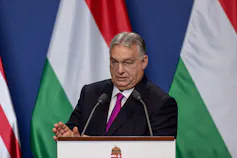
Along came a cynical populist-nationalist politician, Viktor Orbán. Orban started manipulating these grievances, and did so to significantly divide Hungarian society. He attacked many of the institutions of democracy, which were increasingly unpopular because of people’s grievances. He went after elites, and foreigners, and migrants, and the media. And he blamed all of them for the country’s problems. He then was able to ride these grievances into office.
Once in office, Orban amended the constitution and laws relating to the parliament. He undermined the independence of the media and the judiciary so as to centralize power. All of this happened while I was running an international university in Budapest, which remained independent because it received no funding from the Hungarian government. We were able to resist the increasingly authoritarian regime over issues of academic freedom. The government tried to shut down our programs of migration studies and gender studies, and tried to censor aspects of our history department.
These authoritarian attacks are similar to what we’ve seen happening in the U.S., and in fact, Viktor Orban was greatly admired by Donald Trump, and a lot of the playbook that Orban has followed was mirrored in Project 2025 in the U.S. under Trump.
BD: How do communities respond in different ways to authoritarian regimes?
OK: Pro-democracy movements and protection types of movements at the local level often co-occur. For example, in Colombia there have been various leftist movements and political parties that have pushed for greater democratic opening while communities mobilize to keep people safe and help them cope with repressive conditions. In places like Chile, El Salvador and Guatemala, communities built trust and support networks to provide aid, such as for people who needed food assistance. This provides space to independently operate and preserve the community.
The U.S. has parallels, such as innovating early warning networks to get advance notice of risks and threats, by communicating using the Signal app. In the Democratic Republic of Congo, villages set up radio networks, and in Ukraine they have sophisticated early warning networks to get word of airstrikes and drone attacks.
Fact-finding and countering stigma are important, and in the U.S. we’re seeing that in the form of the video recording and publicizing of harmful actions. This has played out similarly in Syria with fact-finding to protect nongovernment organizations.
There’s also accompaniment where outside actors come in to provide support to communities. Around the world, church organizations play important accompaniment roles. We’re seeing clergy in the U.S. step up and visit places that are at risk.
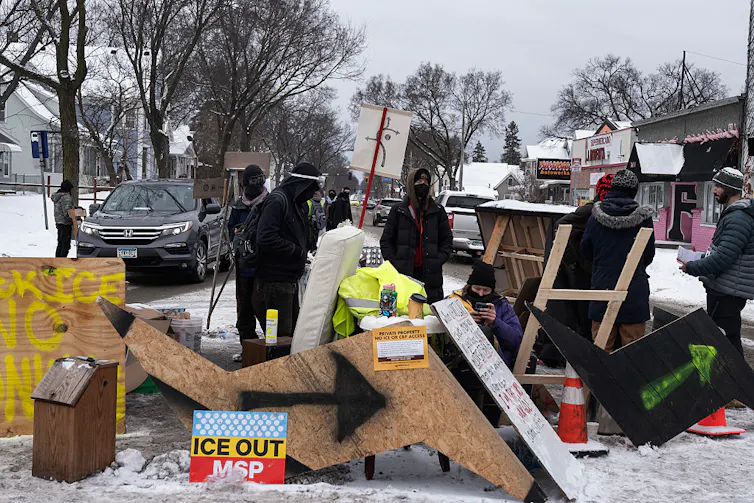
And then, there are protests, the most visible kind of action. In Minnesota, we’ve seen communities actually setting up community barricades, which has also happened in Mexico, Colombia and Northern Ireland. Communicating the nonviolent nature of these movements is important to avoid any pretext for additional crackdowns.
I think Americans have been taking similar actions to places around the world in part because there are some similar background conditions: repression and strong social capital networks. Those two things come together to produce these strategies.
BD: Could you speak more about the need to build a clear narrative and a positive one?
JS: There are two basic rules for how to resist authoritarianism that I’ve learned from experience: Build a diverse coalition and develop a unifying theme. You need a diverse coalition in order to appeal to a broad range of the public, and in order to do that, you need agreement on the goal and values of what you’re trying to accomplish. You need a clear and unifying narrative. The narrative often involves economic issues and issues of corruption, since there’s often a great deal of corruption in authoritarian regimes.
Hungary will have its next parliamentary election in April in which Orban will seek his fifth term as prime minister. The opposition has developed a broad coalition and a unifying theme, while Orban is using the centralized instruments of government and media that he controls to try to manipulate public opinion. The opposition coalition is headed by Peter Magyar, who was once a major supporter of Orban’s government. Magyar’s name can be magical in Hungary – sort of like a “Joe America” in the U.S.
With Magyar as its head, the opposition is aiming to peel off supporters of the regime. It’s campaigning on economic grounds, with a positive message and on moderate terms. And most importantly, it includes parties from the left, right and center.
Poland has succeeded in doing what the Hungarian opposition is attempting. It managed to vote out an authoritarian government by putting together a broad coalition to defend the independence of the Polish judiciary. That became a coalition to elect parliamentarians in 2023, and that succeeded in changing the government.
BD: How important is the preexisting social fabric of a community to the success of a protest movement?
JS: It’s important, but complicated. Hungary had a very weak civil society after 70 years of totalitarian fascism and communism. When I was there, the very word to “volunteer,” which we think of as the essence of community action and service, was seen to be a bad word in Hungarian because it was closely associated with collaborating with the regime.
In the U.S., we’re the opposite in a sense, although the U.S. is now slipping on this. We have a long history of volunteerism, we have all these civil society organizations, we have a tradition of barn raising, people getting together with their neighbors and doing things in their communities. This is very much a part of the American spirit and a core value.
But today, I would say a combination of consumerism and economic individualism coming out of decades of economic deregulation has caused our civil society to fray. But the authoritarian challenge that we face now, and the way in which we are beginning to respond to it, is in fact bringing communities back together again. I think what happened in Minneapolis is an example of that. And this may reflect a growing capacity to resist an authoritarian regime.

Former President, Central European University (2009-2016)
Oliver Kaplan does not work for, consult, own shares in or receive funding from any company or organization that would benefit from this article, and has disclosed no relevant affiliations beyond their academic appointment.
from The Conversation – Articles (US) https://ift.tt/YpHPdRa
 Reviewed by Admin
on
March 27, 2026
Rating:
Reviewed by Admin
on
March 27, 2026
Rating:


No comments: